
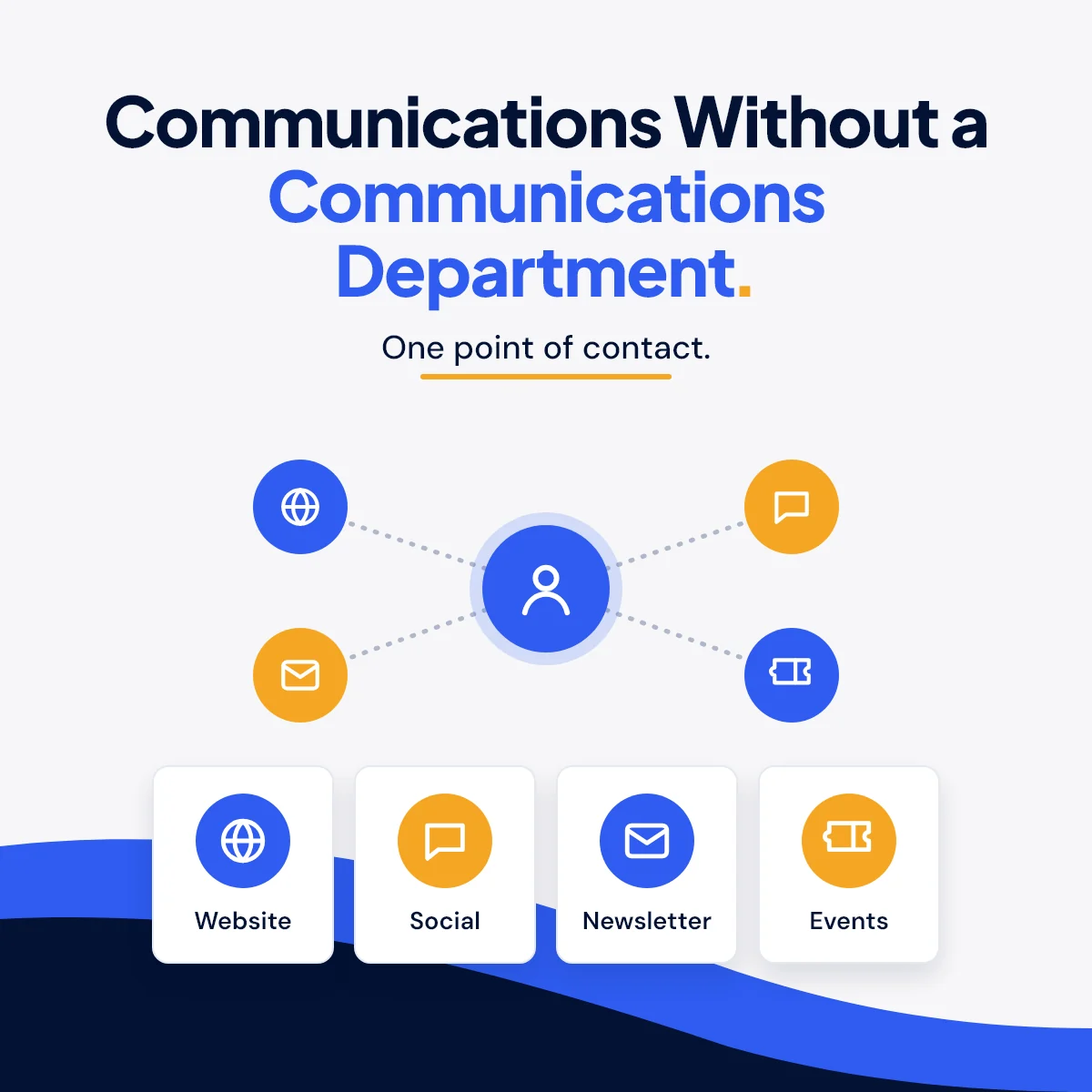
Communications Without a Communications Department
In a lot of associations, nonprofits, and small organizations, communications belongs to everyone and no one. The website is somebody's third job. The newsletter is a volunteer's project. Social media gets handled by whoever has a free minute, and the next event gets promoted when someone remembers.
Nobody is doing anything wrong. They're just doing it on top of everything else. Here's how to tell when that arrangement has stopped working, and what your real options are.
Signs Communications Has Fallen Through the Cracks
- The event date on the website doesn't match the one on Facebook.
- The quarterly newsletter went out twice last year.
- Nobody is quite sure who has the website login.
- Every flyer, email, and social post looks like it came from a different organization.
- A board member asks, "Did we ever post about that?" and no one knows.
- Event promotion starts three weeks out, and registrations come in late or not at all.
If three or more of these sound familiar, the problem isn't effort. It's that no one person owns the whole picture.
Why Splitting It Up Costs More Than It Looks
When four people each handle one channel, you get four voices, four schedules, and a lot of handoffs. Information gets lost between the person who knows the event details and the person who posts about them. Nobody owns the calendar, so the website, newsletter, and social media drift out of sync.
And the people doing it usually have other jobs that come first. Communications slides every time something urgent comes up, which is often.
Your Real Options
1. Keep it with staff and volunteers
The lowest cash cost, and sometimes the right call for very small groups. The tradeoff is consistency. When a volunteer moves on, the knowledge, logins, and files often go with them.
2. Hire someone in-house
A dedicated person is a real solution if you can afford one. To give you a sense of scale, the U.S. Bureau of Labor Statistics reports that the median annual wage for public relations specialists was $74,750 in May 2025. On top of wages, benefits made up 30.0% of total compensation for private-industry workers in June 2026.
Put those together and a rough estimate for one full-time communications person lands a little over $100,000 a year, before software, training, and the time it takes to hire. That's back-of-the-envelope math with national figures, and your local numbers will vary, but it's the right order of magnitude.
3. Hire several freelancers
A web person, a social media person, a designer for the newsletter. Each may do good work, but now you're the project manager, the one keeping everyone on the same message and the same schedule.
4. One outside partner for all of it
One person who handles the website, social media, newsletter, and event promotion under one plan. You get one point of contact, one calendar, and one consistent voice, without adding a full-time salary.
What One Plan Should Cover
Whichever route you choose, communications works best when it runs from one calendar. Take a single event:
- The event page and registration go live on the website.
- The newsletter announces it with a link to register.
- Social posts build up to it: announcement, featured details, reminders, a countdown.
- Sponsors get materials that match everything else.
- After the event, a thank-you post and a recap in the next newsletter.
When one person plans all five, they reinforce each other. When five people each do one, they compete.
Get the Email Basics Right
If you send a newsletter, keep a few basics in place. Use a real email platform with a clear unsubscribe link and your organization's mailing address in the footer.
For commercial email, those aren't just good manners. The FTC's CAN-SPAM compliance guide says your message must include a valid physical postal address and a clear way to opt out, and that you must honor opt-out requests within 10 business days. If you're not sure whether your newsletter counts as commercial, the guide explains how to tell.
Keep Some Things Inside
Even with outside help, some things should stay with someone inside your organization: approving what goes out, handling complaints, answering questions about money or private member information, and making calls only leadership can make. A good partner sets those lines clearly at the start so nothing falls between you.
What This Looks Like in Practice
I do this today for ASA Colorado, the Colorado chapter of the Automotive Service Association, which doesn't have a marketing department. I act as one, under their name and branding, not mine. Each month that covers keeping their websites current, designing every graphic and newsletter in their visual identity, running a content calendar across Facebook and Instagram, producing the quarterly member newsletter start to finish, and tracking membership renewals. Right now it also includes planning and running their 2027 Summit.
That's what my Marketing & Communications service is: one person, one plan, one voice. There are two levels:
- Comms Partner, $1,500–2,000/month: website management and updates, ongoing social content, a monthly or quarterly newsletter, and one point of contact.
- Comms + Events Partner, $2,500–3,500/month: everything in Comms Partner, plus event page and registration support, sponsorship and campaign materials, and board- and stakeholder-ready reporting.
There's a 3-month minimum, and nonprofit pricing is worked out case by case rather than as a flat discount.
If your website is somebody's third job, that's my conversation. Tell me what's currently split across too many people and I'll help you figure out the right fit.
Sources
- U.S. Bureau of Labor Statistics, Occupational Outlook Handbook, "Public Relations Specialists" (median annual wage $74,750, May 2025): https://www.bls.gov/ooh/media-and-communication/public-relations-specialists.htm
- U.S. Bureau of Labor Statistics, "Employer Costs for Employee Compensation – June 2026" (benefits 30.0% of total compensation, private industry): https://www.bls.gov/news.release/ecec.nr0.htm
- Federal Trade Commission, "CAN-SPAM Act: A Compliance Guide for Business" (postal address, opt-out, honor within 10 business days): https://www.ftc.gov/business-guidance/resources/can-spam-act-compliance-guide-business
Not sure how your site holds up on a phone, or for someone using a screen reader? I can take a look.
Start a Project