
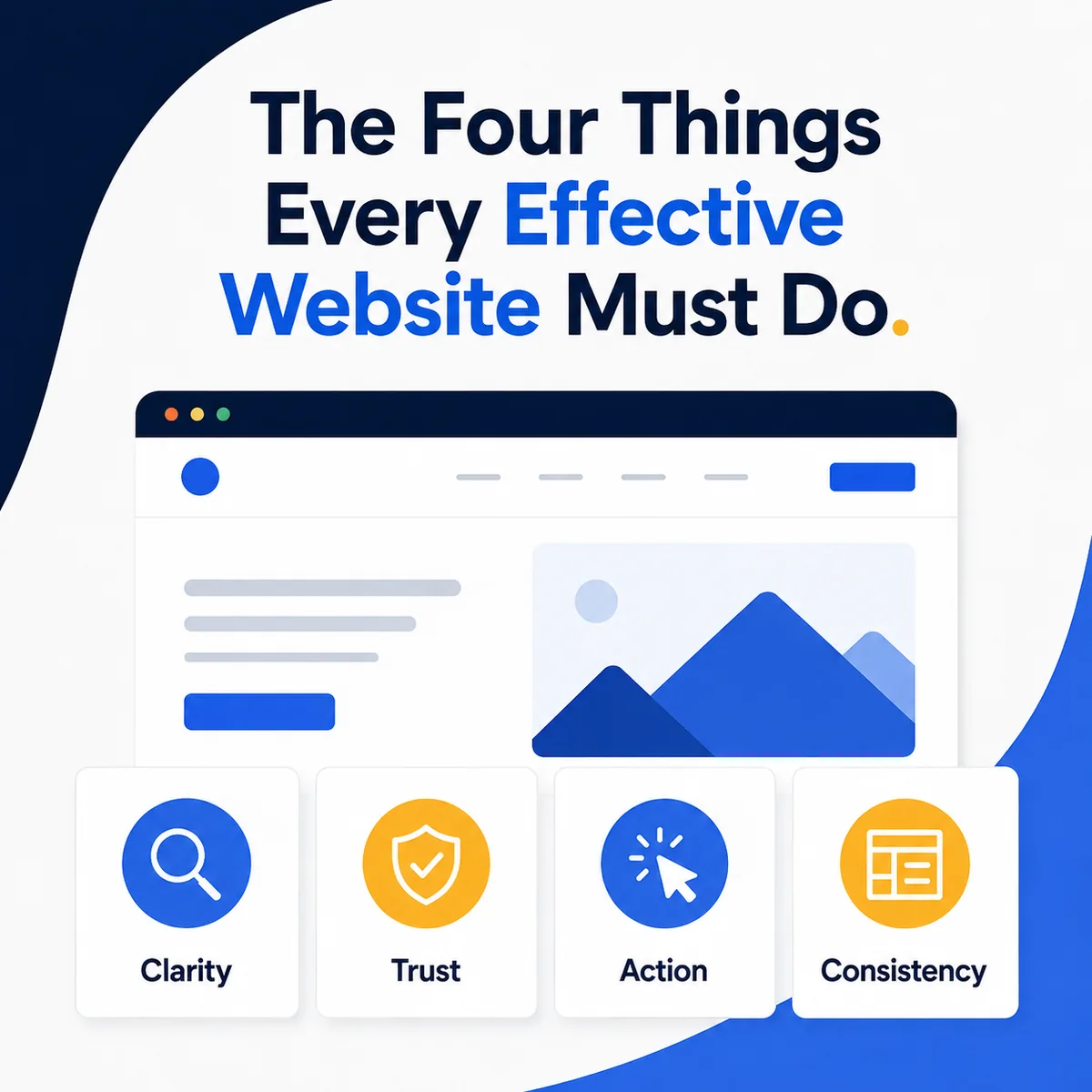
The four things every effective website must do
A successful website does not begin with colors, animation, or clever technology. It begins with a clear understanding of what the website needs to accomplish.
Whether your organization sells services, recruits members, accepts donations, schedules appointments, or promotes events, your website must help visitors make decisions. To do that effectively, it needs to perform four essential jobs:
- Clarify what you do.
- Build trust in your organization.
- Guide visitors toward an appropriate action.
- Present a consistent brand experience.
When one of these elements is missing, even an attractive website can struggle to produce meaningful results.
1. Clarify What You Do
A visitor should not have to study your homepage to understand your organization. Within moments, people should be able to answer three basic questions: What does this organization do? Who does it serve? How can it help me?
Unfortunately, many websites begin with vague statements such as “Solutions for a changing world,” “Innovative service. Exceptional results,” or “Helping you reach your full potential.” These phrases sound polished, but they provide very little useful information.
A stronger homepage headline communicates something specific:
Professional carpet and air duct cleaning for homes and businesses throughout Northern Colorado.
That statement immediately identifies the service, audience, and geographic area.
Website visitors tend to scan pages rather than read every word in order. Clear headings, short paragraphs, descriptive buttons, and strong visual hierarchy help people find the information that matters to them.
Clarity is not about reducing every page to a few sentences. It is about organizing information so visitors can quickly understand the main message and then explore additional details when they are ready.
2. Build Trust
Once visitors understand what you do, their next question is usually: Can I trust this organization?
Trust is established through a combination of design, content, and evidence. Useful trust signals may include:
- Customer testimonials
- Reviews
- Case studies
- Professional certifications
- Membership affiliations
- Years of experience
- Staff photographs and biographies
- Completed project examples
- Community involvement
- Clear contact information
- Privacy, security, or service guarantees
Strong website design also contributes to credibility. Inconsistent fonts, outdated information, broken links, low-quality images, and pages that perform poorly on mobile devices can make an established organization appear less professional than it really is.
The most persuasive websites do not merely claim to be experienced or dependable. They provide evidence.
- Instead of saying, “We provide outstanding service,” show a testimonial explaining what made the service outstanding.
- Instead of saying, “We are industry experts,” publish an article that answers a difficult customer question.
- Instead of saying, “We create excellent results,” show the work and explain the outcome.
3. Guide Visitors Toward Action
Every important page should help visitors understand what they can do next. Depending on the organization, that next step might be to request an estimate, schedule an appointment, register for an event, make a donation, become a member, view available services, download a resource, call the business, send a message, or visit a location.
A common website mistake is presenting information without providing a clear path forward. A service page might thoroughly explain a service but end without a button, contact form, phone number, or related page. The visitor reaches the bottom and must decide where to go next. The website should make that decision easier.
Calls to action should use clear, specific language. “Request an Estimate” communicates more than “Submit.” “Explore Website Services” is more descriptive than “Learn More.”
Not every visitor is ready to contact you immediately. Some may need to review examples, read testimonials, compare services, or learn more about your process. A good website provides different next steps for people at different stages of the decision-making process.
4. Stay Consistent
Your website does not exist in isolation. It is part of a larger brand experience that may include social media, email marketing, business cards, proposals, brochures, presentations, event materials, advertising, and signage. These materials should feel as though they come from the same organization.
Consistency includes more than using the same logo. It also involves colors, typography, photography, illustration styles, messaging, voice, terminology, button styles, and calls to action.
A visitor who moves from your social media profile to your website should recognize the same organization. When the visual style and message change dramatically between platforms, confidence can erode. Consistency creates familiarity, and familiarity makes an organization easier to recognize, understand, and remember.
Design Should Support the Message
Visual design is important, but it should support these four objectives rather than distract from them. A website does not succeed because it contains the latest design trend. It succeeds because the design helps visitors understand the organization, trust what they see, and confidently take the next step.
Before redesigning your website, ask:
- Is our message immediately clear?
- Have we provided enough evidence to build trust?
- Does each important page offer an appropriate next step?
- Does the website accurately represent the rest of our brand?
Those questions provide a much stronger foundation than simply asking whether the website looks modern. A thoughtfully designed website brings strategy, messaging, design, and functionality together. When all four are working in concert, the website becomes more than an online brochure. It becomes a practical business and communication tool.
Not sure your site is doing all four of these? I can take a look and tell you what is missing.
Start a Project