
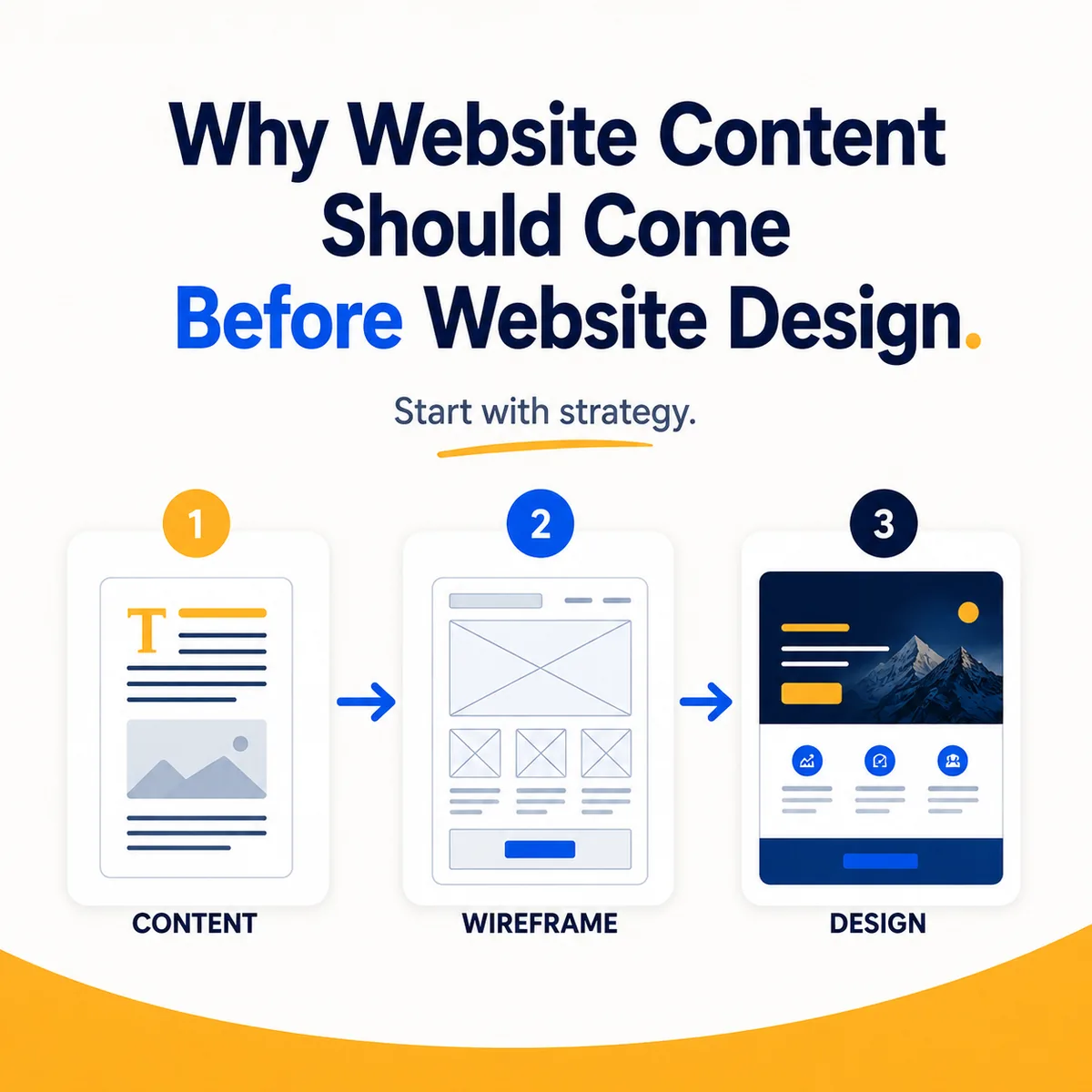
Why website content should come before website design
Many website projects begin with visual questions. Which colors should we use? What should the homepage look like? Should the design feel modern or traditional? Where should the photographs go? What animation should we add?
These decisions matter, but they are not the best place to begin. Before designing the website, you need to understand the content it must communicate.
Design Is the Delivery System
A website’s design helps organize, prioritize, and present information. Without content, the designer does not know which message deserves the greatest prominence, how much space each section requires, which pages are necessary, what evidence supports the organization’s claims, where visitors should be guided next, or what photographs and graphics are needed.
Designing first often leads to forcing the content into a predetermined layout. Important explanations get shortened because the template has limited space. Weak sections remain because the design requires another box. Calls to action are added without considering what visitors are actually ready to do.
A better process allows the content to inform the structure. Smashing Magazine describes content as a fundamental part of the web-design process rather than material that should be inserted after the visual work has been completed.
Start With the Audience
Effective website content begins with the people who will use the site. Ask:
- Who are they?
- What problem are they trying to solve?
- What information do they need?
- What concerns might prevent them from acting?
- What terminology do they use?
- What do they need to believe before contacting us?
A business owner may describe a service according to the internal process. A prospective customer is more likely to think about the problem, desired outcome, cost, timing, or risk. The website needs to connect those perspectives.
For example, an organization might internally refer to a program as the “Community Resource Navigation Initiative.” Visitors may be looking for “help finding local housing and food resources.” Both terms may belong on the page, but the visitor’s language should receive priority.
Google similarly recommends using the words people use when searching for information, and creating content for people rather than primarily for ranking systems.
Define the Purpose of Every Page
Every page should have a primary objective. A homepage might orient visitors and direct them toward services. A service page might explain the problem, approach, process, and next step. An About page might establish credibility and personal connection. A case study might demonstrate how the organization solves problems. An event page might provide the information someone needs to register.
When a page has no clear purpose, it often becomes a collection of unrelated information. Before writing, complete this sentence:
After reviewing this page, the visitor should understand ______ and be prepared to ______.
This establishes both a communication goal and an action goal.
Build a Useful Page Structure
Most website pages benefit from a clear information hierarchy. A service page might include a clear statement of the service, the problem it addresses, who the service is for, what is included, the process, evidence or examples, frequently asked questions, and a call to action.
This structure follows the visitor’s natural questions: What is this? Is it relevant to me? How does it work? Can I trust you? What happens next?
The visual design can then emphasize those answers through headings, spacing, photographs, icons, testimonial blocks, and calls to action.
Write for Scanning and Reading
Visitors do not all consume content in the same way. Some will scan the headings and buttons. Others will read every paragraph before making a decision. Your content should support both behaviors.
Use descriptive headings, short paragraphs, bulleted lists where appropriate, important information near the beginning, specific link and button language, plain language, and visual separation between topics.
A heading such as “Our Services” provides limited information. A stronger heading might be “Website Design Services Built Around Your Organization’s Goals.” The second version communicates meaning even when the visitor only scans the page.
Replace Claims With Evidence
Website copy frequently relies on unsupported adjectives: experienced, trusted, innovative, professional, high quality, customer focused, results driven. These descriptions are not necessarily false. They are simply more persuasive when supported by evidence.
Instead of “We are an experienced website-design company,” try:
Picture This Creative Services has developed websites and communication materials for businesses, nonprofits, membership associations, and community organizations.
Instead of “We provide personal service,” try:
You work directly with the person planning, designing, and developing your project.
Specific evidence makes the content more credible and gives the design something meaningful to highlight.
Plan Visual Content at the Same Time
Content includes more than written copy. It may also include photographs, diagrams, icons, videos, charts, documents, testimonials, logos, project examples, and before-and-after comparisons.
Create a content inventory before design begins. Identify what already exists, what needs improvement, and what must be created. This prevents last-minute substitutions such as generic stock photographs that do not accurately represent the organization.
Content and Design Should Develop Together
“Content first” does not mean every sentence must be final before any design work begins. Content and design often improve through collaboration.
A preliminary content structure informs the initial design. The design may then reveal that a section needs to be shortened, divided, expanded, or presented visually. The copy is refined, and the design evolves with it. The important distinction is that the website is not designed as an empty shell with the expectation that meaningful content will somehow fit later.
A Better Foundation Produces a Better Website
Your website’s appearance creates an impression. Its content determines whether visitors understand and believe that impression.
When content strategy comes first, the design can emphasize the strongest message, organize complicated information, direct attention appropriately, support different visitor needs, reinforce credibility, and create a clearer path toward action.
Good content and good design are not competing priorities. They are parts of the same communication system.
Have a project where the content and the design need to develop together? Tell me what you are working on.
Start a Project