
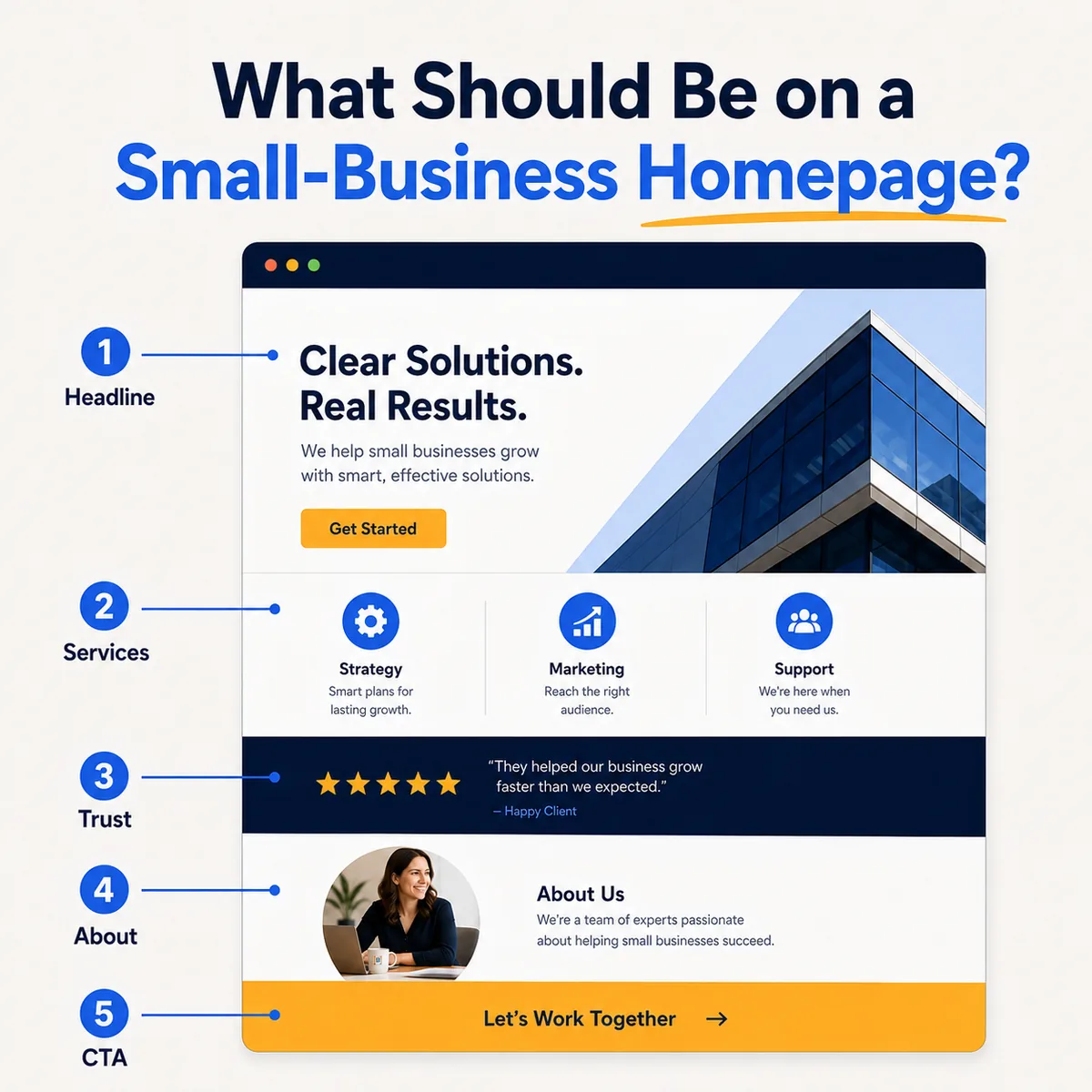
What should be on a small-business homepage?
Your homepage does not need to tell visitors everything about your organization. It does, however, need to help them quickly understand where they are, what you offer, and where they should go next.
Think of the homepage as a well-organized introduction. It should present the most important information, establish confidence, and provide clear pathways into the rest of the website. Here are the essential elements of an effective small-business or organizational homepage.
A Clear Opening Message
The top section of the homepage, often called the hero section, should clearly explain what your organization does. A strong opening section generally includes a specific headline, a short supporting statement, a primary call-to-action button, and a relevant photograph, illustration, or design element.
The headline should prioritize clarity over cleverness. For example:
Strategic websites and design for businesses and organizations that need to communicate clearly.
A supporting statement can then add context:
Picture This Creative Services brings messaging, design, and practical implementation together to help organizations build trust and guide people toward action.
Some visitors will make their decision before scrolling any further, which is why the top of the page carries so much weight.
A Brief Overview of Your Services
Visitors need a quick way to determine whether you provide what they are looking for. This does not require placing the full text of every service page on the homepage. Instead, provide a concise overview of your primary services with links to more detailed information.
Each service introduction should explain the outcome, not merely name the service. Instead of “Website Design,” try:
Strategic website design that clarifies your message, strengthens your credibility, and gives visitors a clear path forward.
This helps visitors understand both what you provide and why it matters.
A Strong Reason to Choose You
Your homepage should communicate what distinguishes your organization. This might include specialized industry experience, a strategic process, local knowledge, personal service, technical expertise, a unique methodology, long-term client relationships, or an integrated range of services.
Avoid relying entirely on broad claims such as “high quality,” “excellent service,” or “customer focused.” Most competitors make the same claims. Instead, explain what your difference looks like in practice:
Your website, branding, content, and ongoing communications are developed as one connected system, not as unrelated pieces produced by different vendors.
Specificity makes a differentiator more believable.
Evidence and Trust Signals
Do not make visitors search for reasons to trust you. Feature some of your strongest evidence directly on the homepage: a short testimonial, recognizable client logos, professional credentials, awards, review ratings, memberships, project results, years of experience, or community involvement.
Case studies and portfolio examples are particularly useful because they demonstrate your capabilities instead of merely describing them. For a service business, a featured project might explain the client’s challenge, the work completed, the strategy behind the work, and the resulting improvement. This provides considerably more value than a gallery of unexplained screenshots.
A Human Introduction
People frequently want to know who is behind a business, particularly when the work requires collaboration, trust, or an ongoing relationship. A short introduction to the owner or team can make the organization feel more accessible.
Include a professional photograph, a concise personal introduction, relevant experience, your approach to working with clients, and a link to the complete About page. This section should not attempt to tell your entire life story. Its purpose is to help visitors understand who they would be working with and what that experience might be like.
A Simple Explanation of Your Process
Uncertainty can prevent people from making contact. A concise process section helps prospective clients understand what happens after they reach out. For example: discovery and planning, content and messaging, design and development, review and refinement, and launch and ongoing support.
A defined process communicates organization and experience. It also reassures visitors that they will not be expected to figure out the project on their own.
Helpful Content
Recent articles, guides, frequently asked questions, or educational resources can demonstrate expertise and answer early-stage questions. Useful topics might include how to prepare for a website redesign, what information belongs on a homepage, how to select photographs for a website, what website hosting includes, how long a website project takes, or how to evaluate an outdated website.
Google recommends creating content primarily to help people rather than producing pages solely to attract search-engine traffic. A useful article can introduce your organization to someone long before that person is ready to request a proposal.
Multiple Calls to Action
Your homepage should provide several logical opportunities to take the next step. The primary action might be Start a Project, Request a Consultation, Schedule an Appointment, or Get an Estimate. Secondary actions might include View Our Work, Explore Services, Meet the Team, or Read Client Stories.
Avoid placing too many competing buttons in the same section. Each part of the homepage should have a clear purpose.
Complete Contact Information
The footer should make basic contact information easy to find. Depending on the business, this may include a phone number, email address, physical or mailing address, business hours, service area, social media links, a contact-page link, and a privacy-policy link. Local businesses should clearly identify the geographic areas they serve.
Your Homepage Is an Orientation Tool
The best homepage does not force every visitor through the same rigid sequence. It helps different people find the information most relevant to them. One visitor may want to review services. Another may want to see examples. Someone else may be ready to contact you immediately. Your homepage should support all three.
The goal is not to place everything on one page. The goal is to create a clear, credible introduction that encourages visitors to continue.
Wondering what your own homepage is leaving out? Let us talk it through.
Start a Project